"Ideal Meal"
This is a minimalist (few ingredients as possible), enviro-friendly, low-effort, economical diet for peak health/nutrition (esp for joint health and reducing inflammation) using ingredients that are cheap-per-meal and shelf-stable so easy to stock up and minimizes food waste. Each meal has almost all necessary nutrients (need minimal supplements - see list). You could eat nothing but any one of these meals for life and be completely physically healthy. I will add new recipes as they are developed (aiming for around 6 - 10).
Jump To:
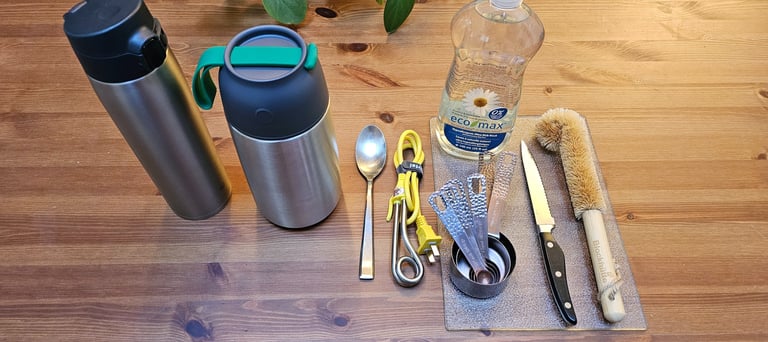
This could be your ENTIRE kitchen!
Strategy:
Based on current research, the ideal frequency of meals for optimum health is 2 meals per day at 10:00 and 18:00. Snacking during the day is fine, but the goal is to fast between 18:00 and 10:00 the next day for optimum gut health. With this in mind, each of the current meals being developed meets AT LEAST 50% of recommended daily intake of every nutrient (protein, healthy fats, vitamins, minerals), plus contain supplemental “super foods” that are shown to optimize brain health, metabolic function, insulin balance, combat inflammation, and promote healing of various organs and tissues (e.g. heart, gut, joints).
There are a few nutrients I couldn't find a good whole-food source for - Vit D, Vit K2, and DHA/EPA. See the “Supplements” section about these and other recommended supplements not part of each recipe.
Upcoming modifications planned include creating complimentary meals that don't contain half the daily recommended intake of each ingredient, but when eaten together in one day do. I might try a strategy of “combine one of these three meals (morning) with any of these other three meals (evening) to get complete nutrition each day”.
Another modification I'm contemplating is to have a fruit/berry - yogurt - hemp heart bowl (plus other ingredients as I figure this out) as a mid-day snack, offloading some of the ingredients from the meals into this to make each meal smaller, possibly make the recipes a little more flexible, and to add a sweet treat with different texture to add variety, plus make the morning and evening meals a little smaller.
Prep:
Pre-measure meals into 14 jars/ziplock bags for the week (minus amla and mustard - these get added once cooked and then cooled down)
To prepare - simply dump 1 pre-measured meal into a 1L food thermos, pour in 500ml boiling water (or whatever the recipe calls for) and give it a few good shakes to mix ingredients and water.
Let stand for 20 - 60min (again, whatever recipe calls for).
Open and let cool. This can take an hour or more if left in the thermos, so this is where the optional bowl comes in. I ordered a cast iron bowl to see if this will help quickly bring the temp down from boiling to edible, but then hold the heat while I eat (vs a regular bowl that would keep cooling it down quickly).
Once cooled to a temperature comfortable to eat, add amla powder and mustard powder just before eating (these have vitamins, antioxidants, enzymes and phytonutrients that are not heat-stable).
Supplements:
Dandelion greens or other bitters at beginning of meal (stimulate digestion and bike release - chew a couple raw leaves or put right on top of the dish)
Vit D (winter)
Algal oil soft gel capsule (Omega 3s DHA and EPA)
• Vit K2 supplement (aka "Mk-7" or "Vit K2-7")
Nettle tea (no closer than one hour before or after eating a meal)


BENEFITS
Inexpensive
Each meal costs around $3.50, so $7/day.
Health
With a consistent nutritional base covering (almost) all your needs in each meal, you don't need to worry about lots of supplements or variety.
With pre-measured meals, the calorie counting only needs to happen once.
Easy Prep
In just half an hour you can pre-measure a week or two of meals into jars (each jar is one meal)
Making a meal is as easy as heating the water and pouring it into the food thermos along with a pre-measured meal, closing it up and giving it a quick shake. Wait the requisite cooking time (no need for stirring or simmering). Serve and add amla and mustard after it has cooled down and enjoy.
Portability
Lightweight, pre-measured meals that need no refrigeration are perfect for camping or throwing in a bag for work.
Cooking can happen on the move - your food can cook while you're walking/hiking/biking/driving/riding the train, etc
Eating out of the thermos can be done anywhere easily. When you're done, put the lid on and it won't get things dirty. Giving the spoon a swipe with a damp paper towel gets it mostly clean as well, or just put it in a plastic bag, or wash it in a sink.
Easy Shopping
Because all ingredients last a month or two at room temp (or 4+ months in a freezer), you can shop infrequently and bulk up.
In fact, all ingredients can be mail-ordered, meaning you don't need to drive to or set foot in a grocery store at all. And if you live remotely, you could have these ingredients delivered to you in the mail.
Zero Food Waste
Because you're only making one meal at a time, there are no leftovers to go bad.
Because all ingredients are long-lasting and shelf-stable, you won't end up with half a squishy cucumber or a moldy half-tub of sour cream in your fridge.
Minimal Energy
The only energy needed is bringing about 1L of water to a boil per day. No energy needed for simmering. It will work with cold-soaking as well. Hot water for beverages (tea) is optional. This is not only environmentally friendly, if you live off-grid or you're camping it means you hardly need any electricity or fuel for cooking, and none for refrigeration.
Environmentally Friendly
Organic, whole food ingredients are minimally processed, requiring little energy or machinery and no chemicals.
Most ingredients require very little land or water to grow.
These foods are very nutrient and energy-dense, and often shipped in bulk, so there is very little energy for shipping a given amount of calories, and minimal packaging is needed. Waste should be a few plastic bags per month, especially if reusing bags when shopping in the bulk aisle.
As already noted above, energy needed for preparation is extremely minimal and there's no food waste.
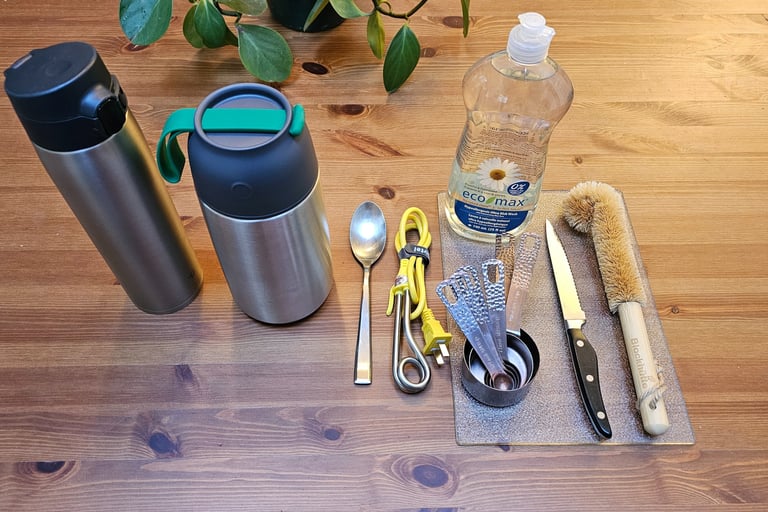
Extremely Minimalist Kitchen
This is literally all you'd need for your entire kitchen. From left to right in picture above (mostly):
Beverage thermos (or just a mug)
1L food thermos
Spoon
Immersion heater (use to boil water directly in thermoses)
Measuring cups/spoons
Knife and cutting board (for fresh veggies and fruits)
Dish soap and bottle brush
What you don't need:
Fridge/freezer*, stove, microwave, toaster or toaster oven, slow cooker, rice/pressure cooker, electric kettle, blender, mixer, dishwasher, bowls**, plates, cups, pots, pans, baking trays, mixing bowls, loaf pans, casserole dishes, tupperware, aluminum foil, plastic wrap, drawers full of serving spoons, spatulas, whisks, etc. etc. etc. Literally your entire “kitchen” could just be what's pictured plus a bin to store your dry ingredients and spices.
You could eliminate the need for a kitchen entirely. This would work for tiny homes, micro-appartments, van-lifers, camping, etc. or just people who appreciate minimalism and efficiency.
* If you're stocking large amounts of ingredients that will take you longer to eat than their shelf-life, you can put these in a fridge or freezer.
** Leaving it in the food thermos can take an hour to cool down once it's opened. To speed it up, I initially started putting it in a bowl to cool it down faster (collapsable bowl with a lid when travelling). But another trick I've started doing is using slightly too little water to cook it (it ends up hydrated, but the consistency of chunky peanutbutter), and then adding a small amount of cold water to it once it's cooked and stirring that in. This allows me to stir in the heat-sensitive ingredients and start eating faster while leaving it in the food thermos, as long as I have a source of cold/cool water to add to it (tap, water bottle).
Easy Cleanup, Minimal Water
With no cooking oils and no baking or simmering, there are no greasy pots or pans and no cooked-on food. With a quick soak, everything comes off easily with a small amount of soap - no scrubbing, and barely any water. This is perfect for if you have to manage your gray-water (e.g. camping or van-life).
Reduced Cognitive Load
If I can get a decent number of recipes for different meals, around a dozen perhaps, that mostly use the same core nutritional ingredients, that should be enough variety to rely solely on these meals most of the time. This would significantly cut down on decision fatigue.
Grocery shopping would just be getting a replacement bag when one gets low, with minimal ingredients and spices to keep track of.
With a week or two of meals prepped, there's no thinking about what's needed from the store, or what you have ingredients for, or what's easy to make, etc. - just grab a jar.
Time Reclamation
Between being able to cut shopping down to a minimum (even potentially eliminating trips to the store entirely), plus making it possible to prep a couple week's worth of meals in a half hour, plus cutting hands-on cooking time down to mere seconds, eating this way cuts down a huge amount of time normally taken up in these activities.
Not to mention the time normally taken planning meals, checking ingredients, running back to the store for the one ingredient you forgot, or that you found out went bad, or that someone ate and didn't tell you, packaging up leftovers, cleaning all the pots and pans and cutlery and dishes, putting all that away when it's clean, cleaning the counters and stove, cleaning out the fridge when it collects old leftovers, managing all the garbage and recycling and compost, etc. etc. etc.
Single-Person Friendly
I originally came up with this idea thinking about what I'd eat when my kids move out. I like cooking for others, but not for myself. I'll be more likely to heat up a bowl of soup or make a PB&J sandwich or a pot of ramen. The other alternative is to just eat out. When I do make something nicer for myself, I'll likely have a half a can of beans or a half onion leftover that will probably go bad before I use it. Without enough people eating it, stuff like sour cream will go bad. I'd also resort to getting smaller blocks of cheese and smaller jars of PB, which is usually more expensive per serving than if you're buying larger quantities for a family. The result would be poor health and a lot of money spent on take-away, food waste, and smaller, more expensive quantities.
In contrast, this diet is super easy, super healthy, and quite inexpensive.
I know I'd also have a tendency to leave a pot soaking until I need it again, and let cutlery and mugs pile up, too. By using only one container and spoon, and not having to deal with caked-on, baked-on, greasy stuff, or cutting boards or mixing bowls, etc., cleanup becomes consistent and super easy. And with no compost, I don't have to worry about that filling up and getting nasty either.
Emergency Ready
Should a disaster strike (e.g. earthquake) and you have no power, you can ensure you always have a month’s-worth of your regular diet of healthy, nutritionally-complete food since it doesn't need refrigeration.
And because you only need to boil 1L of water per day (half a liter at a time), without even the need for simmering, that's easy to do on a small, collapsible, camping woodstove (eg Kuvic Compact Titanium Woodstove, pictured) and a 750ml pot using only a tiny amount of wood (like, one medium branch), or a camping stove with a minimal amount of fuel.
© 2026. All rights reserved.