Personal Uniform
Personal Uniform
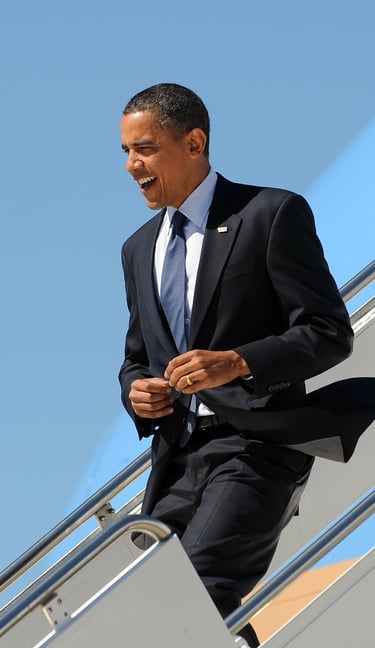
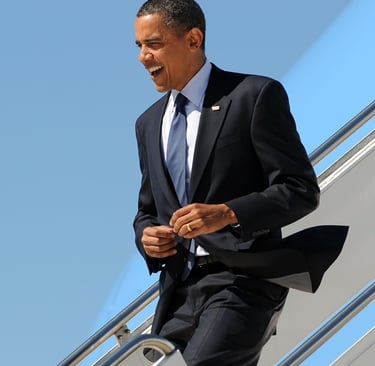
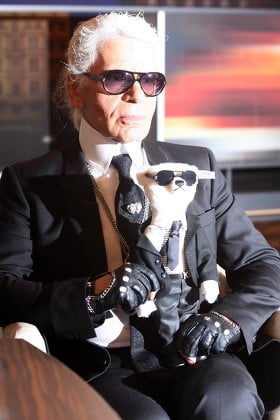
For many years I've utilized a "personal uniform". I literally wear the same thing every day (multiple pieces of the exact same clothing items). It's like a company uniform, except you get to pick what that looks like. Picture Steve Jobs, Barack Obama, Johnny Cash, or Karl Lagerfeld - very different personalities, each with their own unique, signature style. Sometimes it's literally multiple copies of the same exact outfit (Steve Jobs), or just a couple different colours of suit that are alternated (Barack Obama), or a range of different clothes and accessories, but all sharing the same core aesthetic (Johnny Cash or Karl Lagerfeld).
If you're an art director, a construction worker, a personal trainer, a lawyer, a DJ, etc. your look is going to be drastically different. It's not only your profession that provides input on what you choose, there's your personal preferences, the functionality the clothes need to provide, your cultural context, plus what looks good on you. You're coming up with your signature look, the outfit that combines all the elements of who you are and expresses that to the world.
It can take some time and effort to find your signature look. It's a bit of a journey of personal discovery. Also, you tend to be much more selective about getting things "just right" when it's all you wear day in and day out.
You switch from being a consumer to a curator.
The advantages are:
1. Time saving (no more looking for clothes that match, no closet cluttered with stuff you never wear).
2. Avoiding decision fatigue / reducing cognitive load.
3. Higher quality clothes - because it's more important to get clothes you feel good in, you tend to splurge on higher quality.
4. Lower cost - despite the higher quality, you're buying fewer clothes, often more timeless styles you don't have to update to keep up with changing fashions, plus higher quality clothes usually last longer.
5. Enviro friendly - buying fewer clothes means less extraction and processing and fewer clothes going to the landifill vs "fast fashion".
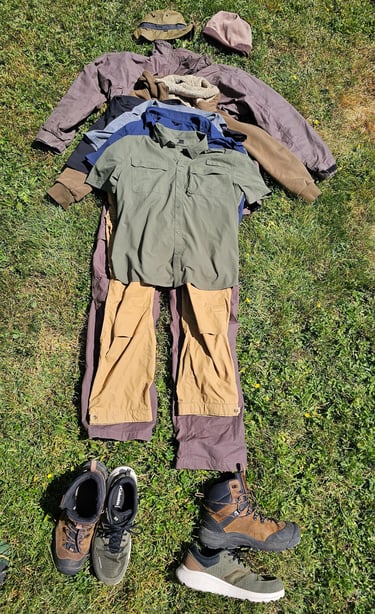
In the morning when I get dressed, I have one kind of pants in one colour, and one kind of shirt in four colours. I tend not to change pants every day, so I just have a few of these, but I have around 10 shirts because I change these every day, plus a few extras stashed in various places (my backpack, my car, and my emergency go-bag).
The key was finding clothes that just kinda worked for everything I personally do. I'll kind of gloss over the main points of why I chose the clothes I did to focus on first-principles, and then go into more detail on each one later. Note this is for me - a generic, middle aged white guy in Canada working as an RMT and living on a Gulf Island. Sharing my thought process is to help you figure out your own process, not to copy me!
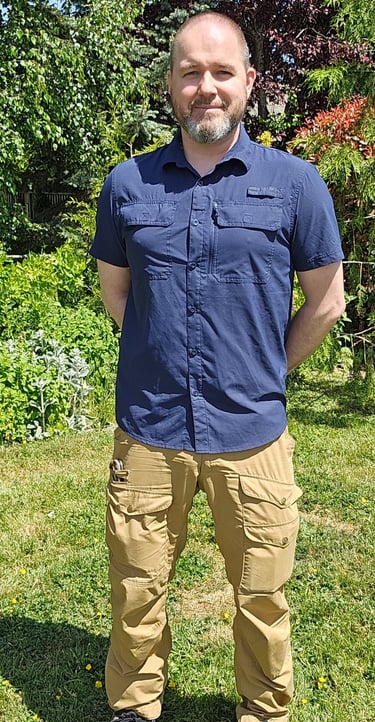
For shirts, I found that the classic button-up, collared, short-sleeve shirt was the ticket. Short-sleeves for working as an RMT (I use my elbones and forearms when working). Buttoned almost all the way up (just the top button undone) it looks fairly formal/professional. One more button undone and, especially with my leather, wooden bead and stone pendant necklace underneath, it looks totally appropriate at a casual party or hanging out at the beach. With a plain T-shirt underneath I can unbutton it all the way for total casualness. (I wear comfy T-shirts and yoga pants at home / for PJs, so I have some plain Ts to draw on).
By buying shirts in four different colours I get some variety, avoid looking like I'm just wearing the same shirt every day, and yet because they are all basically the same and no colour is better than the others, I still don't have to make a choice about which one to grab.
When looking for which specific shirt to get, I initially bought about ten different ones online in different styles, fabrics and brands, around two or three at a time. This helped me learn which length worked, which fabrics felt good, how the height of the buttons was important, how the shirt draped with various numbers of buttons undone was important, getting a collar that didn't sit lopsided or ride too high and brush my chin/cheeks, I learned I liked two chest pockets rather than one or none, etc. I "wasted" a bit of money on this process, but I knew it was necessary to hone in on what I wanted and what truly worked for me (it was for science!) But the result was that I found out exactly what I liked best.
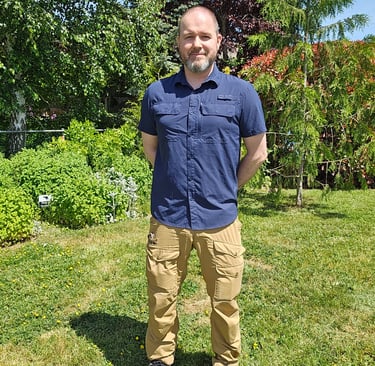
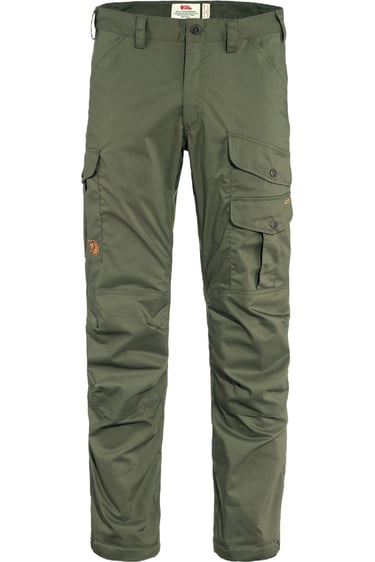
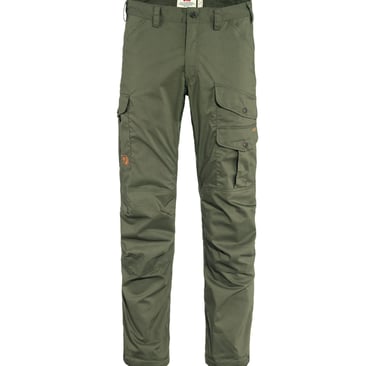
For pants I went with Fjallraven cargo pants. Unlike a lot of cargo pants, their cargo pockets are quite sleek and hold anything in them against your legs so they don't slap against your leg or pouch-out making it look like you're carrying more than you are. I can keep a ton of stuff in them and people can't really tell. So despite being cargo pants made for outdoor recreation, they still look 'nice'. They are a lighter matterial that works in both summer and winter (at least the mild, West Coast winter where I live). There is a gusset that's a stretchy, extra-breathable matterial for mobility and staying cool.
I wear hiking shoes most of the year when I'm not working, and wear the running shoes mostly just when I'm working. Older pairs of shoes become gardening/nipping to the grocery store etc. shoes so my newest ones stay nice for work.
For wearing around home and for PJs I chose nice yoga pants and nice, plain, comfy, cotton T-shirts (nothing old/stained/no stretched-out collar, etc). I can totally nip out to the store, or to pick up one of my kids and his friends, or go to a physical therapy session, etc. without having to change (not that anyone would care where I live anyway!).
The result is a look that is totally versatile and that I feel is "me".
Capsule Wardrobe
The next level of complexity up from a personal wardrobe is the "capsule wardrobe". I won't go into much detail here as that's not my thing, but, especially for women, this works for people who feel they need more variety.
A capsule wardrobe has a number of classic items that act as your base - a "little black dress", a nice pair of jeans, a pair of slacks, a blazer, a sweater, etc. These are all colour-coordinated so you can mix and match each piece with each other piece, as well as adding a few extra pieces of clothing and a range of accessories and shoes/boots/sandals to change up the look.
It's quite incredible how different your look can be by just changing the accessories and shoes, wearing your hair different, and maybe adding a nice jacket or sweater. It's not as minimalist as the personal uniform, but still cuts your wardrobe down to a tiny closet while giving you dozens of different outfits when combined in different ways in order to have variety and to suit any and every occasion.
There is a TON of info and videos about capsule wardrobes online and on YouTube if you're interested in that.
The Specific Clothes I Chose And Why
When you're creating a personal uniform you switch from being a consumer to a curator. It's important to spend some time thinking about what you want it to look like, starting with the most basic principles and working up. E.g. start with your work, your climate, a general colour scheme, and your general preferences. Look in your closet and see if a theme naturally emerges, especially with the clothes you actually wear the most, or the ones you're most excited to wear again. I started wearing cargo pants and hiking boots in highschool, and despite trying a variety of other styles since then, this is what I keep coming back to.
Pants. This is the best place to start designing your personal uniform. The foundation. Since I carry a lot of things in my pockets (a topic for another section), I have a system for what goes where so it rides comfortably and doesn't look too bulky. By having one kind of pant, I only have one pocket layout, and everything I carry just transfers easily from one pair to the next, pocket for pocket.
While these are cargo pants, the cargo pockets are quite sleek - they don't bulge out but rather keep whatever is in them close against your leg. This prevents the stuff in your pockets from slapping against your leg, and makes the overall look a lot more professional for when I'm working. The result is I can carry a lot of things at all times, and the aesthetic is suitable for work, going to the grocery store, or going for a hike or kayak.
Fjallraven is known for making clothing that lasts forever. I also like the look of them. The only two times I complimented a guy's pants they were Fjallraven, and in both cases they looked fairly new but both guys said they'd had them for well over a decade and used them for everything, including chainsawing, gardening, camping, etc. So when it came time to get new pants, these are what I went with. Yes, they're more expensive, but the hope is I won't have to replace them for a very, very long time.
The upside of buying pricier pants is they're super comfortable, a really nice cut, look nicer, have great mobility, thoughtful features, etc. that you only get with more expensive clothing. I tried other brands and styles as well, and always brought with me the things I wanted to carry in my pockets to make sure they would all fit nicely. Eg some pockets narrow at the bottom and so the things I put in jumbled up. Some, the pockets were too far forward and my battery bank slapped against my leg when walking. That kind of thing. The pants I got almost seem like they were made specifically to hold the things I carry.
For the shirts, I found some marketed as fishing shirts, but they have a great cut, they work with one, two, or three buttons undone without looking silly at any step, and they fit me well. Like the Fjallraven pants, they have numerous pockets but they're sleek and lie flat. They have pen sleeves, a tiny loop for hanging your sunglasses, two chest pockets, with one of them having a zippered Napolean pocket under the main chest pocket, and a patch of microfiber cloth sewn into the hem for cleaning glasses or camera lenses.
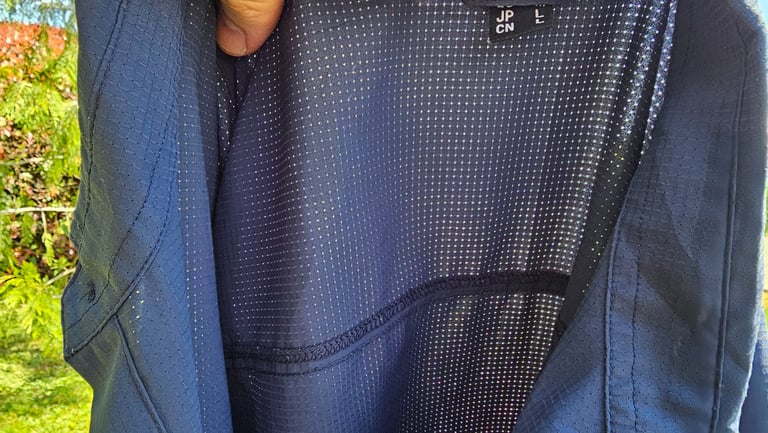
Also, they had a range of colours I liked (I knew I wanted a variety of colours, and some shirts only came in one or two colours I liked). Further, they have a high SPF rating, and yet are super ventilated. This is important for me because I strongly prefer breathable clothing. I actually originally ordered these shirts by accident, because I was avoiding fully synthetic clothing because it's typically like wearing a sweaty plastic bag, and these shirts are 100% polyester. But they have tiny holes every few mm in a grid pattern that makes them positively breezy! The polyester makes them lighter than a basic cotton T-shirt despite all their extra features. They're also super packable and dry very fast. Because I like preparedness, and one of the things I always carry is a small laundry kit (an ultralight dry bag for washing in, a few laundry sheets, and a laundry line), having them dry way faster than cotton or even marino was a plus. So they really met all my criteria super well!
The shoes I wear for work are walking/running shoes. They look casual nice, more style-oriented than regular walking/running shoes. Yet I like (again, for preparedness reasons) that if I needed to I could and have walked for kms in them. They're also very comfy to work in - highly breathable with good foot/arch support. The hiking boots are for most of the year when it's rainy and cold. I leave the running shoes at work (one pair at my clinic in Saanichton, and another at my clinic on Pender) and usually wear the hiking boots.
My rain gear and hoodie and hats I don't feel are really worth going into. So that's it for my personal uniform. I guess I need to make a post about all the things I carry now...8P
A note about natural fabrics and the environment. I prefer the feel and look of natural fabrics. When I started this journey I stuck to mostly hemp and wool. But this didn't last long-term for a few reasons.
Environmentalism. I started with unbleached, undyed (or naturally dyed) fabrics that were organically grown, or wild harvested, hand processed and fair trade. This was supposed to use the least water and land and chemicals.
However, I found these clothes didn't look good for long. The fabric bagged out and lost it's shape, it showed stains easily and just started looking dingy. This meant it needed to be replaced way more than regular fabrics, largely negating the fact that each individual item was more environmentally friendly. If it takes 1/4 the water to grow and manufacture, but you go through 5X the number of items, you actually come out behind. Also, even clothes that come from organic sources still need a certain amount of energy to process into fabric, sew, and transport. The more items you need because they don't last as long means you quickly lose the advantages of their original environmentally friendliness. I now have mostly synthetic clothes that I hope will last 5 - 10X as long as my previous hemp and wool clothing.
Cost. The natural, organic, fair trade stuff is expensive. For example, I was spending $60 per shirt. These shirts only lasted two, maybe three years before they were getting dingy. To have a 6 or 7 shirts cost me around $400 every two to three years. A new merino sweater every few years was another $120, and so on. It was just getting to be a bit much.
Care. I took pretty meticulous care of my hemp and wool clothing. It took special detergents or soaps and hand washing and hanging to dry. Synthetic fabrics are much easier to care for and take a lot more abuse. I still hang to dry, but instead of a full day to dry, they'll be dry within hours. I can even put the shirts on straight out of the washing machine and they're dry by the time I get to work.
Weight and bulk. The synthetic clothes pack much smaller and are much lighter. Having an extra set of clothes in a vacuum sealed bag in my backpack hardly takes up any room and is very light. I just wouldn't do that with my previous natural clothing due to them being so large and heavy.
So that's why I have switched back to synthetic after trying to stick with organic, natural matterials for about 15 years. I will probably stick with merino wool for sweaters, though.

(click image for full size)
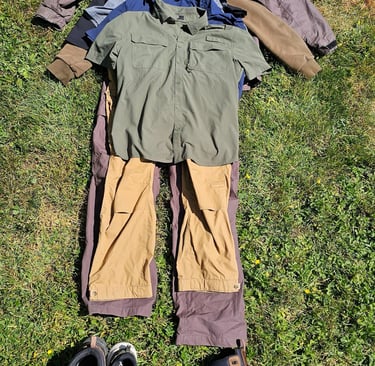
This shows each individual element in my personal uniform - rain gear on the bottom, the hoody and pants on top of that, the collared shirts on top of that in each of the four different colours (black, grey, blue, green). The hats and shoes above and below. While I have multiples of the pants and shirts, this shows how many different items there are to choose from. Most choices are just weather-based (rain gear, hat, shoes, hoody).
The only real "choice" is shirt colour, and I don't really "choose" which colour shirt to wear so much as just grabbing the next one on the rack (though I might make a small effort to wear a different colour than the day before, this doesn't always happen).
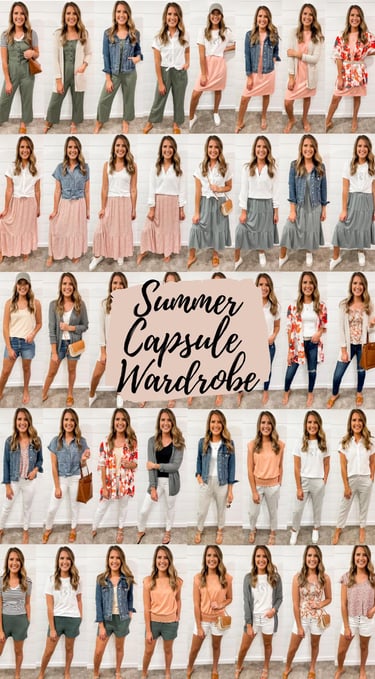
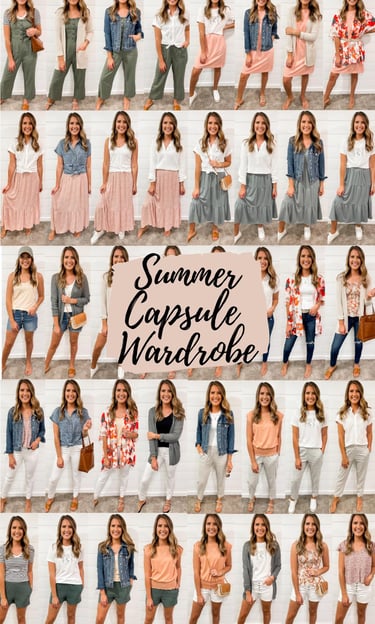
(image from Clothed In Grace)
This shows how a small number of core items can be mixed and matched to produce different looks.
© 2026. All rights reserved.